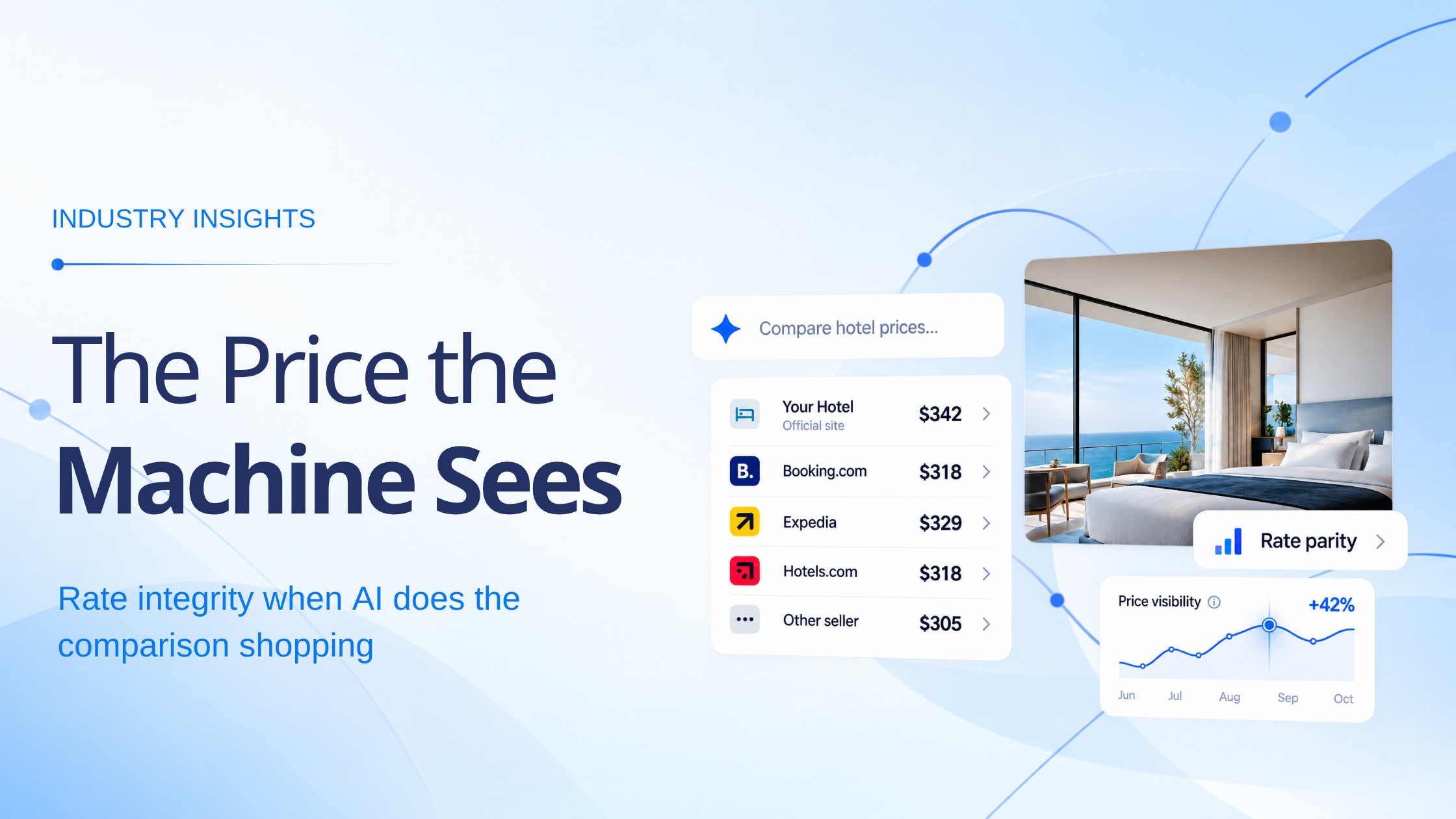
Rate integrity when AI does the comparison shopping
Originally posted on LinkedIn by Kris Glabinski
In an AI-mediated market, your price is the cheapest visible copy of it, not the rate you loaded. Comparison is already automated, and leakage is already common. I think revenue teams that manage price integrity continuously, the way they manage pricing, will pull ahead of those still running parity audits.
1. The shopper changed faster than our playbook
56% of active U.S. travelers used AI on at least one trip in the past year, up from 33% in early 2025. Google added price tracking for individual hotels in April, and in August began rolling out hotel booking inside AI Mode in the U.S. [1,4,5]
Travelers still mostly book with brands they trust. In Expedia’s survey, 68% prefer a trusted travel brand even when AI booking is available. But to me that trust gap is about where people transact, not where they compare. And comparison is exactly what AI is good at: it doesn’t tire at the third tab or forget the cheaper price it saw. [7]
2. Parity isn’t holding, and our edge is narrowing
51% of European hotels report OTA undercutting, up from 43% in 2023. 80% of those affected say they never agreed to the lower price. [2]
World Parity Monitor’s H1 2026 data across Google Hotels searches shows the direct rate was not the cheapest option in 73.4% of searches. The figure that stuck with me: the share of comparisons where hotels win on price fell from 45% to 40%, while ties rose from 22% to 26%. We aren’t losing many more comparisons. We’re winning fewer. When an assistant lines offers up side by side, a tie rarely breaks our way. [3]
3. Most leakage starts where we aren’t looking
The big OTAs aren’t the main culprits. Booking.com, Hotels.com and Expedia undercut in roughly a quarter of comparisons, while several secondary and metasearch-driven sellers undercut in most of theirs, often with rates sourced from wholesalers. [3]
Expedia Group’s survey of 2,000+ hoteliers found 49% of wholesale sales go to unintended partners, and hoteliers estimate they lost 6% of revenue to leakage last year. Those are self-reported numbers from a company with a stake in B2B distribution. Still, they point the same way as the HOTREC and search-level data. [6]
4. Why AI raises the stakes
Comparison becomes exhaustive. One rogue reseller can become the headline price in an AI answer.
Undercuts trigger alerts. 42% of travelers use, or would use, AI to monitor prices, so a brief undercut can reach a guest who was ready to book. [7]
We see less of the journey. Skift reports that Google passes partners only the minimum booking data, not the conversation behind it. [8]
5. Checklist: from parity checks to price integrity
☐ Ask the machines. Query AI assistants and Google for your property on peak, shoulder and same-day dates. Who shows the lowest price?
☐ Track beat / meet / lose, not just violations, by booking window, device and length of stay.
☐ Put distributors in your compset. Your toughest competitor may be someone reselling your own room.
☐ Trace leaks to source with test bookings and rate codes, then take the evidence to the contract conversation.
☐ Set response targets for the 0–7 day window, where exposure peaks.
☐ Give direct a tie-breaker: flexibility, perks or member rates.
☐ Align content across every channel an assistant can read.
My take
We spent a decade optimizing the price we set. The next few years will reward the hotels that are just as disciplined about the price the market displays. This is the problem I spend my days on with our team at Aggregate Intelligence and TRAVIS, and whatever tools you use, the principle holds: you can’t protect a price you can’t see.
Sources
[1] Phocuswright, The AI Surge (summary), Mar 2026. https://www.phocuswright.com/Travel-Research/Research-Updates/2026/The-fastest-shift-in-travel-behavior-just-became-the-default
[2] HOTREC, European Hotel Distribution Study 2026, 15 Sep 2026. https://www.hotrec.eu/en/policies_booking-holdings-and-expedia-group-account-for-85-of-europe_E2_80_99s-ota-market-hotrec-study-finds.html
[3] 123COMPARE.ME / World Parity Monitor, H1 2026 analysis, 6 Oct 2026. https://123compare.me/en/ota-rate-leakage-wpm-2026/
[4] Google, individual hotel price tracking, 17 Apr 2026. https://blog.google/products-and-platforms/products/search/summer-travel-tips-google-search-ai/
[5] Google, hotel booking in AI Mode, 27 Aug 2026. https://blog.google/products-and-platforms/products/search/book-travel-ai-mode/
[6] Expedia Group, hotel B2B distribution study, 29 Sep 2025. https://partner.expediagroup.com/en-us/resources/blog/hotel-b2b-distribution-study
[7] Expedia Group, The AI Trust Gap (YouGov), 14 Apr 2026. https://ir.expediagroup.com/news-and-events/news/news-details/2026/Expedia-Group-Reveals-The-AI-Trust-Gap-Travelers-Embrace-AI-for-Planning-but-Rely-on-Trusted-Brands-to-Book/default.aspx
[8] Skift, Google’s Agentic Hotel Booking Tool Comes to AI Mode, 27 Aug 2026. https://skift.com/2026/08/27/googles-agentic-hotel-booking-tool-comes-to-ai-mode/