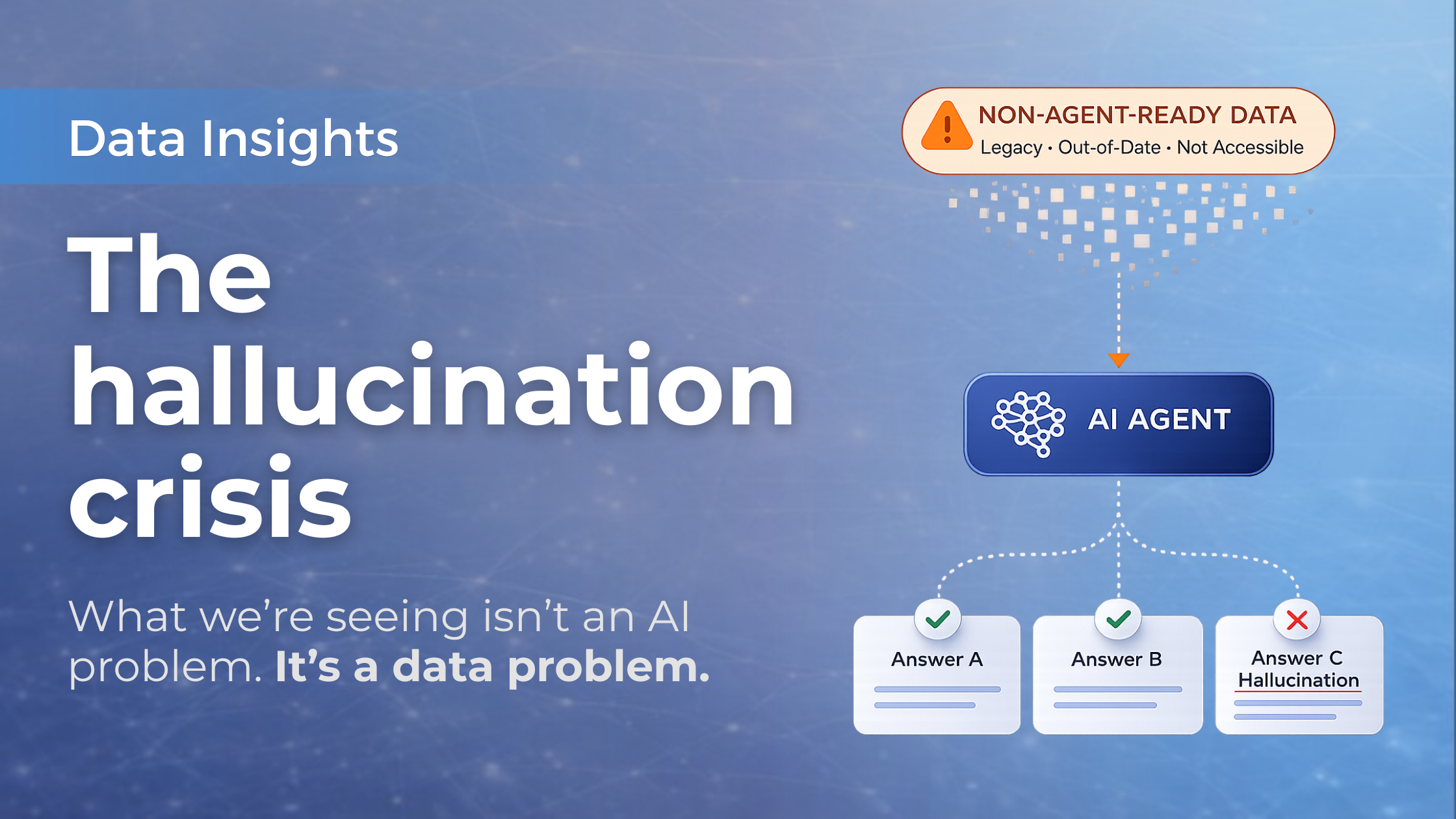
Enterprise AI initiatives are at risk of failure, not because the models aren’t capable, but because they are being fueled by legacy, unstructured data dumps.
What we’re witnessing isn’t a limitation of AI itself. It’s a failure of data readiness. Until organizations address that gap, hallucinations will continue to undermine even the most advanced systems.
This challenge is part of a broader shift in how we think about AI.
A shift is happening
As Kris Glabinski highlights in his article on AI hallucinations, today’s systems can be remarkably powerful and dangerously wrong at the same time. His core point is clear: bad data doesn’t just reduce performance; it actively distorts outcomes.
Over the past two years, AI has become dramatically easier to deploy. Models are stronger, tooling is more mature, and agent-based systems are rapidly proliferating. But while intelligence has become more accessible, accuracy has not kept pace.
The problem isn’t the agent. It’s the data behind it.
Hallucinations are a data problem
Modern AI is a prediction engine. It generates responses that are fluent and probable, not guaranteed to be true. When the data it receives is incomplete or ambiguous, it fills in the gaps.
That is a hallucination.
When an AI is given raw datasets or static extracts, it sees values but not meaning. It does not understand what a number represents, how fields relate, or what context is missing. Without semantic clarity, it interpolates from patterns it has seen before and effectively guesses.
The output is not an obvious failure. It is a polished, confident answer that looks like an executive summary. It sounds right. It reads well. And it is often wrong.
This is what makes hallucinations so dangerous. They are persuasive.
Error rates can climb into the 15 to 30 percent range when models operate on poorly structured or context-light data. Not because the model is weak, but because the inputs are.
A simple example
One of our clients recently asked an agent to recommend the best hotel rate.
The agent selected a $120 option as the best value. Clear, confident, and seemingly correct.
But the $120 excluded tax, was priced per night, and was non-refundable. A $135 option included tax, offered flexibility, and was a better room.
The agent did exactly what it was supposed to do.
The data did not.
And this is not an isolated case.
In travel, these errors happen constantly. An AI may compare a $500 airline fare on a direct channel with a $550 fare on an OTA and conclude the OTA is overpriced, without understanding that the OTA price includes additional services. It may treat two flights as competitors when they are actually codeshare partners on the same aircraft. It may interpret a high price as a competitive signal, when it simply reflects zero inventory.
In every case, the conclusion is logical, well presented, and wrong.
The hidden impact
This is what makes the problem dangerous.
AI systems appear to work. They produce answers, automate workflows, and build trust. But small errors accumulate underneath. Decisions drift. Revenue leaks.
In highly dynamic sectors like travel, those errors translate directly into missed opportunities and margin loss.
The failure is subtle, not obvious.
The real issue
Most data was designed for humans, not machines. Humans can interpret missing context. AI cannot. It takes inputs at face value.
At the same time, much of the industry still relies on static data delivery. Daily drops. Batch extracts. Fixed snapshots.
But you cannot run real-time decisions on static data. A dataset delivered in the morning is already outdated by the afternoon.
If AI agents are fed stale, ambiguous data, they will hallucinate, miscalculate, and produce misleading outputs. Not because they are broken, but because they are operating without the context they need.
What Agent-ready data looks like
Agent-ready data is not just structured. It is understandable, contextual, and accessible in real time. It has semantic clarity. A price is not just a number. It defines what it includes, how it is calculated, and how it relates to other fields.
It has rich context. Attributes like “price including tax”, “per stay”, or “room type code” remove ambiguity and enable correct comparisons.
And it is on-demand. Not a static snapshot, but live data that an agent can retrieve at the moment of decision.
This is why APIs matter. They allow agents to query current, contextualised data directly, rather than rely on pre-packaged extracts.
Instead of forcing an AI to infer meaning from ambiguous columns, the meaning is built into the data itself.
The takeaway
The competitive advantage in AI is shifting. It is no longer about who has the best agent. It is about who has data that those agents can trust.
If you are still thinking about what file to send, you are asking the wrong question.
The real question is how an agent will access, understand, and act on your data independently. And increasingly, the answer is not a once-daily, unstructured data dump. It is on-demand, API-delivered, agent-ready data.
We are entering a phase where intelligence is abundant, but reliable data is not.
The systems that succeed will not be the ones with the smartest agents, but the ones built on data those agents can actually use.