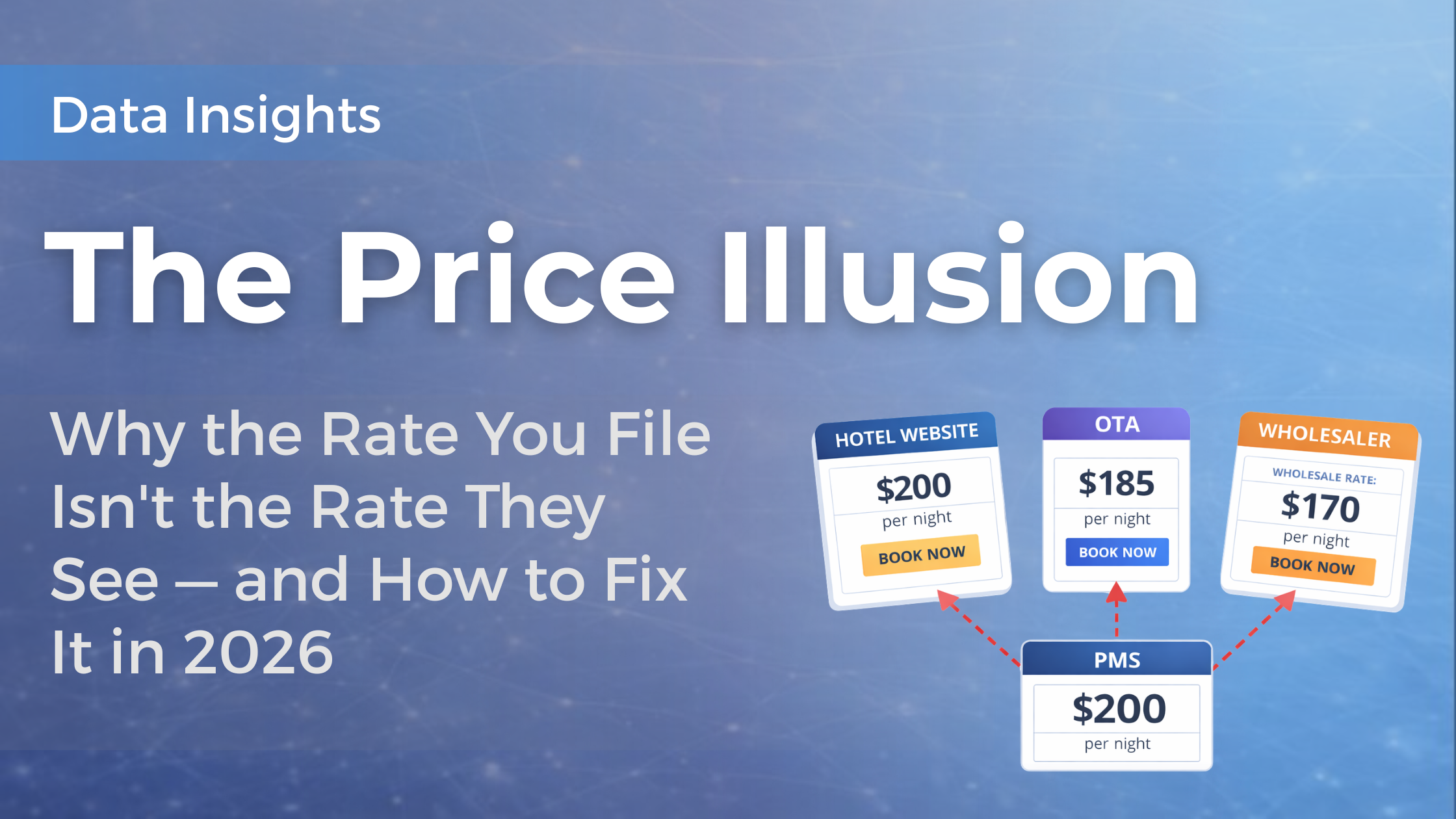
For modern hoteliers, the most frustrating discrepancy in distribution is the “Disconnected Ledger.” You file a rate of $200 in your Property Management System (PMS) or Channel Manager. Yet, when a customer searches on an OTA or metasearch engine, they see $185. Or worse, your brand website displays a price that is undercut by a “ghost” rate from a wholesaler you thought you disconnected months ago.
By 2026, this issue has evolved from a simple nuisance into an existential threat to hotel profitability. The disparity between filed rates (hotel input) and actual rates (customer view) is no longer just about contract violations; it is about the inability of legacy hotel systems to communicate with the new, high-speed AI infrastructure that now dominates travel search. With rate leakage affecting up to 98% of hoteliers, understanding the mechanics of this disparity is the first step toward regaining control. [ref: 25 Trends Reshaping Hotel Distribution in 2026 – White Sky Hotel Consultancy & Training]
The Mechanics of Disparity: Where the Fare Changes
The gap between the price you set and the price the guest pays is often created in the murky middle layer of distribution.
The OTA “Margin Cut” and Buying the Box Online Travel Agencies (OTAs) are not passive billboards; they are aggressive retailers. To win the “Buy Box” on Google Hotel Ads or other metasearch platforms, OTAs often shave their own commissions to undercut the hotel’s direct rate. If an OTA creates a price disparity, they are effectively treating the guest as their own asset, masking data and controlling the transaction terms. This often results in the hotelier losing the direct booking because their own “Best Rate Guarantee” is technically undercut by a partner they authorized.
Wholesale Leakage A significant portion of rate disparity stems from wholesale inventory intended for bundled packages leaking onto public channels. These “unbundled” rates appear as standalone offers, bypassing the fences intended to protect public pricing. Because 49% of hoteliers struggle with disconnected data silos, tracking the source of this leakage is often a manual, reactive process rather than an automated defense. [ref: The Irreversible Shift: Why Your Distribution Model Must Be AI-Native by 2030 – travhotech]
Technological Lag and Caching The disparity is also a symptom of technological latency. Legacy distribution relies on caching—storing static snapshots of rates. However, modern consumers and AI agents demand real-time data. If a hotel’s API cannot handle the volume of requests, intermediaries serve cached (and often outdated) prices. This results in “ghost rates” that frustrate customers and damage brand trust.
The New Gatekeeper: Agentic AI
In 2026, the distribution landscape has shifted from human-led search to “Agentic AI”—autonomous bots that execute tasks rather than just retrieving information. This shift is “seismic,” forcing an API-first mandate on the industry.
The Path of Least Resistance Agentic AI is designed to find the best option for the guest, ruthlessly prioritizing the lowest price and the most complete data. If a leaked wholesale rate exists in the digital ecosystem, the AI agent will find it. Because OTAs possess superior technical stacks capable of processing billions of API calls with standardized content, AI agents naturally gravitate toward them as the “path of least resistance”.
The AI Transaction Tax This technological advantage creates a new “AI Transaction Tax.” The money hoteliers save on human sales efforts is redirected to pay the AI’s gatekeepers—either through OTA commissions or escalating costs for visibility in AI-driven search results like Google’s Gemini. As the industry moves from cost-per-click to “cost-per-agentic-search,” hotels that cannot feed accurate, real-time rates directly to these agents will be forced to pay intermediaries to do it for them.
The Financial Impact: The Cost of Losing Control
The discrepancy between filed and actual rates has severe financial consequences beyond the immediate loss of revenue.
Commission Erosion The most obvious cost is the 15% to 30% commission paid to OTAs for bookings that might have been direct. For a 30-room hotel, this can amount to hundreds of thousands of dollars annually in lost margin.
Rising Acquisition Costs (CAC) Competing with your own partners drives up the Cost of Acquisition (CAC). Digital ad costs have risen 20% to 40% year-over-year in some sectors. When a hotel must bid against an OTA for placement on a metasearch engine—often to display a rate that the OTA is already undercutting—the efficiency of marketing spend collapses.
Revenue Management Blind Spots Perhaps the most dangerous impact is strategic blindness. If a hotel cannot see the actual rate the customer paid due to opaque OTA models or leakage, they cannot accurately forecast demand or manage yield. The industry is attempting to move toward metrics like Revenue Per Available Guest (RevPAG) to measure total profitability, but this requires a unified view of the customer that disparate rates obscure.
Strategic Responses: Regaining Control
To close the gap between filed and actual rates, hoteliers must move beyond static distribution models and adopt “AI-native” and “social-first” strategies.
Shift to AI-Native Distribution The future of distribution lies in “AI-native architecture.” This means having a unified data layer that allows the hotel to provide real-time, rich, and dynamic data through a single API call.
- Structured Data: Hotels must optimize their content for “Generative Engine Optimization” (GEO), ensuring that AI agents can read and verify the official direct rate as the most authoritative source.
- API Supremacy: The goal is to make the direct channel the easiest data source for the AI to access. If the hotel provides the most complete product profile (room + dining + spa) instantly, the AI agent has an incentive to bypass the intermediary.
Social Commerce and Native Checkout To bypass the rate disparity war entirely, hotels are turning to social commerce. Platforms like TikTok and Instagram now allow for “native checkout,” where the discovery and booking happen within the app.
- Closed-Loop Pricing: By embedding booking links directly into social content (e.g., a “Link in Bio” or “Swipe Up”), hotels create a closed loop. The rate displayed here is controlled entirely by the hotel, free from OTA scraping or margin shaving.
- Reduced Friction: This method shortens the customer journey from inspiration to transaction, significantly reducing CAC and increasing net profit. It allows hotels to reach niche markets with specific, attribute-based offers that OTAs cannot easily commoditize.
Here is an enhanced conclusion for the article. It integrates the necessity of tracking “actual rates” using competitive intelligence tools, drawing specifically on the “Rate Leakage Visibility” trends identified in the White Sky Hospitality report.
Conclusion: From Static Parity to Dynamic Intelligence
The era of maintaining “rate parity” through static contracts is ending. In 2026, the battle is for “data sovereignty”. The discrepancy between filed rates and actual rates is a symptom of a distribution model that has not kept pace with technology.
However, adopting AI-native architecture and social commerce is only half the solution. To truly close the gap between the price you file and the price the guest pays, you must be able to see what they see. This necessitates a shift from internal verification to external validation using competitive intelligence tools like Aggregate Intelligence.
With 98% of hoteliers affected by rate leakage, relying solely on PMS data is no longer sufficient; it leaves you blind to the “actual rates” displayed to customers on opaque channels and metasearch engines. By utilizing advanced intelligence tools, hotels can transition from reactive dispute management to “predictive intervention”. These tools allow you to track customer-facing rates, identifying exactly when and where a wholesaler is unbundling rates or an OTA is shaving margins.
Ultimately, the winners of 2030 will not just be those who control their inventory, but those who audit their reality. By combining AI-native distribution with the forensic visibility of Aggregate Intelligence, hoteliers can ensure that the price on the contract is the price on the screen-securing not just revenue, but the trust of the future traveler.