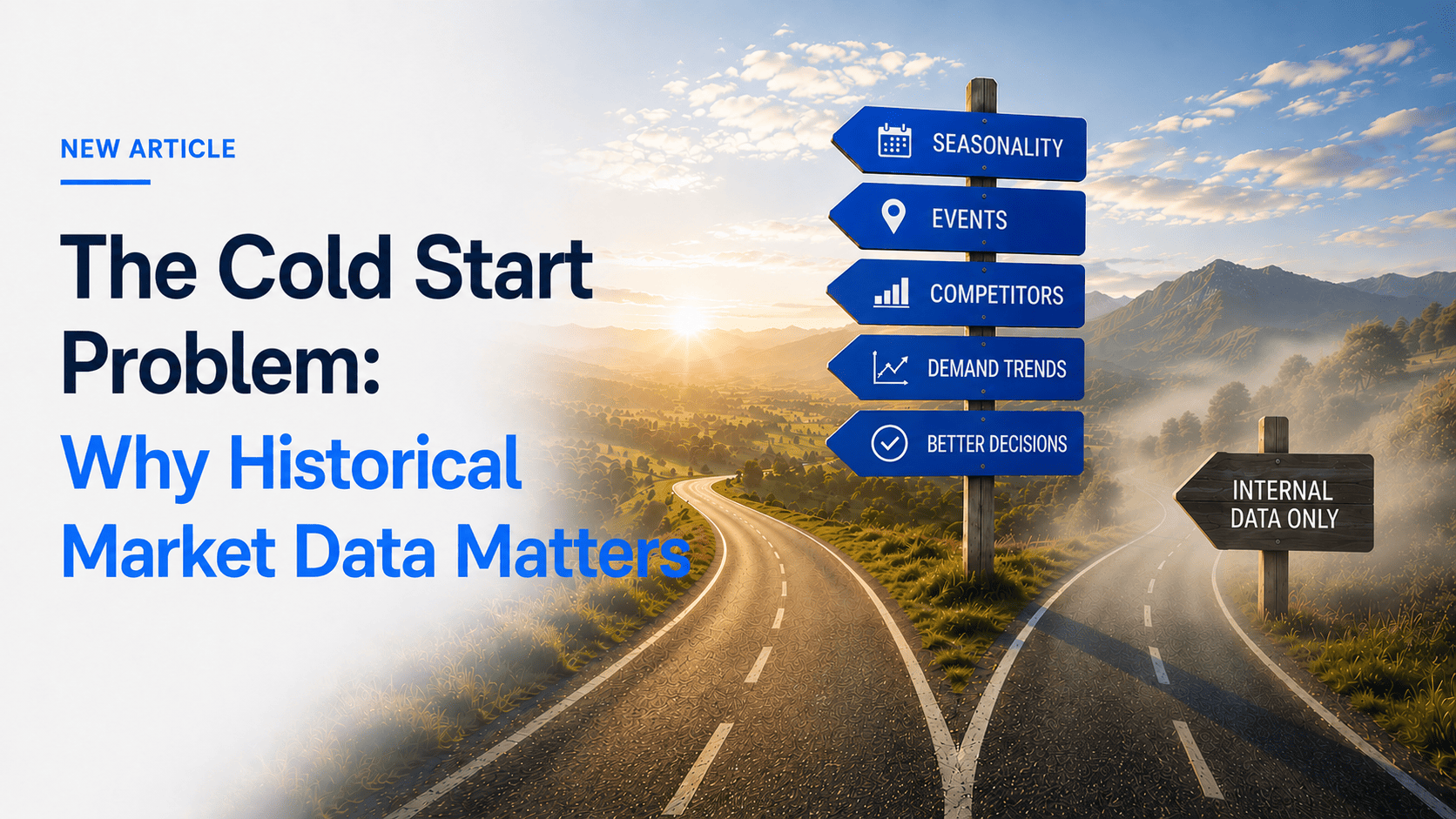
When a new pricing or forecasting model goes live, there is an obvious problem: you may have plenty of your own historical data, but very little history on the market around you.
Most hotels will already have their own historical performance data to work with. What they may not have is the same historical view of their competitors and the wider market.
What were competitors charging at the same time last year? How did the wider market move? What happened to rates around a major event?
This is where historical market data becomes particularly valuable. It gives a new model external context from the start, rather than waiting months or years to build that picture itself.
Starting from zero
Take a new hotel pricing algorithm.
On day one, it can collect current room rates across the market. After a month, it has a month of historical data. After six months, it has six months.
But it still hasn’t seen a full year.
That makes it much harder to understand whether something happening in the market is genuinely unusual or simply part of a normal seasonal pattern.
A sudden increase in rates could indicate a change in demand. Or it could happen at exactly the same time every year.
Without the history, it’s difficult to know.
The obvious solution is to wait and let the model build that history itself. But that can mean spending months, or potentially years, building a dataset before you have enough context to properly understand the market.
There is another option: give it the history from the start.

Why historical data makes such a difference
If you can give a new model two years of historical pricing data on day one, you’re starting from a very different position.
Instead of waiting to discover seasonal patterns, it can analyse them immediately.
It can look at how rates changed last summer, what happened around Christmas, how competitors behaved during major events and how pricing changed at different booking windows.
Historical events data can add another useful layer of context here. If you know that a conference, festival or major sporting event took place at the same time as a previous spike in rates, the model has more information to help understand why the market moved, rather than simply seeing that it did.
For forecasting and pricing models, that context can be extremely valuable.
It doesn’t mean the model suddenly knows everything. It will still need current data and it will continue learning as market conditions change.
But it isn’t starting completely blind.
Turning a number into context
Consider something as simple as a hotel rate of $285.
On its own, that number doesn’t tell you very much.
Even knowing that the rate has increased 18% doesn’t necessarily tell you whether something unusual is happening.
Add historical data and you can start asking much more useful questions.
What is the typical rate for this time of year? What was the rate during the same week last year? Is $285 outside the normal historical range? How are competitors pricing? Was there a similar increase around a comparable event previously?
The current rate hasn’t changed. What has changed is the amount of context around it. And that’s ultimately what historical data provides.
This is becoming more important with AI. The same principle applies to the new generation of AI tools being developed across travel.
There is understandably a lot of focus on the AI itself: which model is being used, what it can do and how sophisticated it is.
But the data underneath it is just as important. For example, you could ask an AI analyst: “Are hotel rates unusually high in London this week?”
Current rate data can tell it what hotels are charging today.
Historical rate data gives it something to compare that against. Historical events data can provide another piece of the puzzle by showing whether there were events taking place during previous periods of unusually high or low demand.
The AI can start looking at what happened during the same period last year, whether the current movement is normal for August, whether competitors are behaving differently and whether similar market conditions have occurred before.
Suddenly, it has much more context to work with. And ultimately, better context should lead to better analysis.

Not all historical data is equally useful
There is a practical issue here as well.
Having two years of data somewhere in a database isn’t necessarily the same as having two years of data that a model can actually use.
If you’re combining information collected from different sources, at different times and in different formats, there can be a significant amount of work involved in cleaning and structuring it.
For companies building new pricing engines, RMS platforms or AI products, that can become a project in itself.
Ideally, historical data should already be structured and ready to integrate into the system you’re building.
Giving new models a head start
At Aggregate Intelligence, we have 24+ months of historical hotel room rate data covering more than 3 million hotels globally, alongside historical events data that can provide additional context around changes in market demand.
That data can be used by companies developing pricing engines, forecasting models, RMS platforms, benchmarking products and new AI applications.
The idea is fairly simple.
If you’re building a new system today, you shouldn’t necessarily have to wait until 2028 to have two years of historical market data.
You can start with it now.
Your model will still learn from what happens tomorrow.
It just doesn’t have to start from zero.